
About ICPC
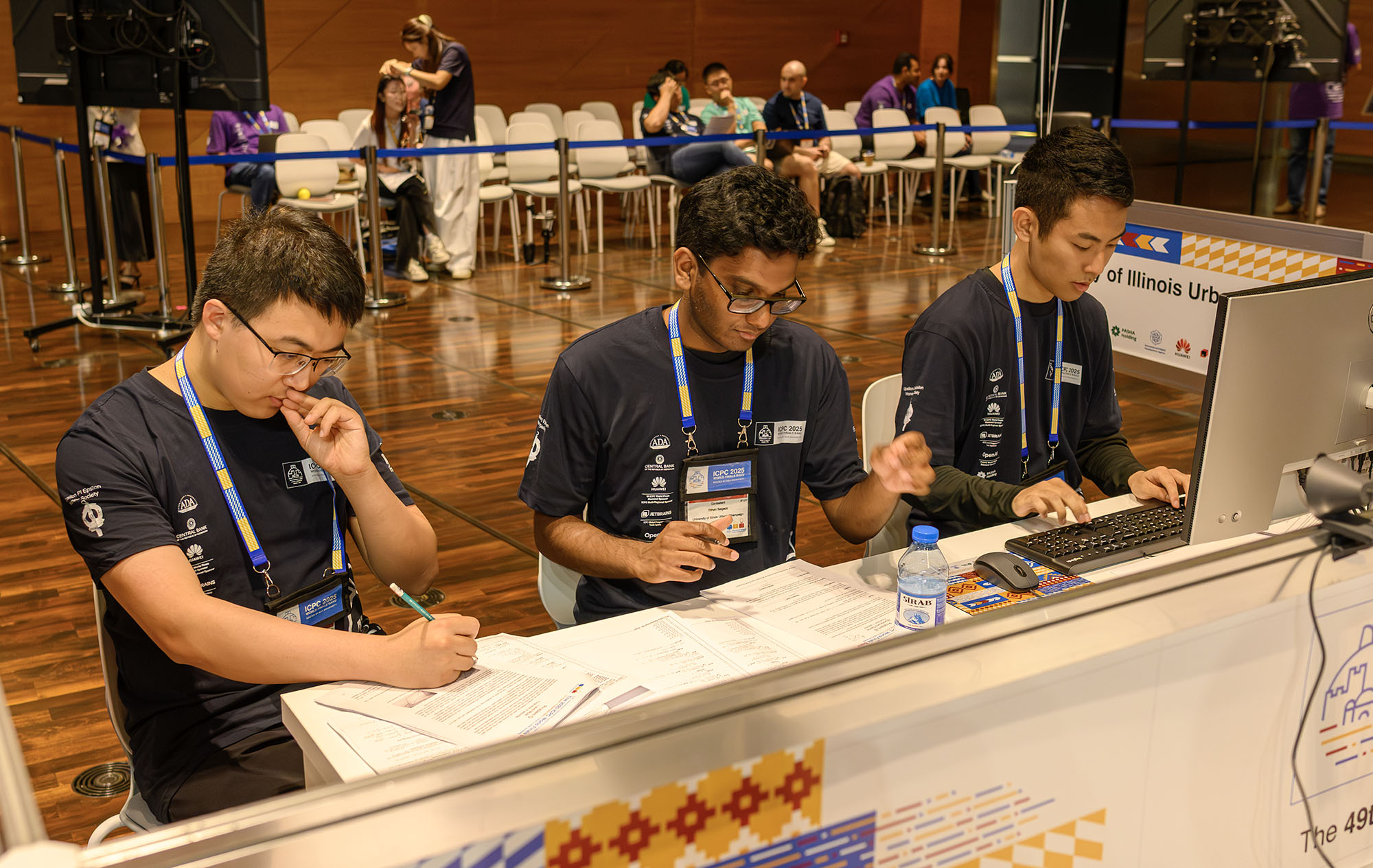
The International Collegiate Programming Contest is an algorithmic programming contest for college students. Teams of three, representing their university, work to solve the most real-world problems, fostering collaboration, creativity, innovation, and the ability to perform under pressure. Through training and competition, teams challenge each other to raise the bar on the possible. Quite simply, it is the oldest, largest, and most prestigious programming contest in the world.
The ICPC traces its roots to 1970 when the first competition was hosted by pioneers of the Alpha Chapter of the UPE Computer Science Honor Society. The initiative spread quickly within the United States and Canada as an innovative program to raise ambition, problem-solving aptitude, and opportunities of the strongest students in the field of computing.
The contest fosters creativity, teamwork, and innovation in building new software programs, and enables students to test their ability to perform under pressure. The contest has raised aspirations and performance of generations of the world’s problem solvers in the fields of computing sciences and engineering.
The International Collegiate Programming Contest (ICPC) is the premier global programming competition conducted by and for the world’s universities. The ICPC is affiliated with the ICPC Foundation.
The ICPC features several levels of competition:
- Local Contests
- Regional Contests
- Regional Championships
- World Finals
World Final Rules
Mission
Introduction
Organization
Team Requirements
Attendance
Support and Prizes
Conduct of the Finals
Scoring of the Finals
Computing Environment
Contestant Conduct
Participant Conduct
Plaques, Medals, Trophy, and Certificates
World Championship Awards
World Finalist Acknowledgement
Championship Honors Awards
World Championship Divisions
First Solution Award and the First To Solve Awards
Championship
Mission
01
Introduction
02
Teams first compete in regional camps, practice contests, and qualifiers for ICPC Regional Contests held around the world annually, typically beginning in the 3rd or 4th quarter, advancing to ICPC Regional Championships scheduled from the end of the 4th quarter to the 1st quarter of the following year. Top teams advance from the ICPC Regional Contests and the ICPC Region Championships to the ICPC World Finals to compete in the 2026 ICPC World Championship as teams from up to 140 universities worldwide.
The 2026 ICPC World Finals is coming soon, hosted by Dubai Chamber of Digital Economy in Dubai. This contest year, 60,948 students have competed on 35,480 teams with 12,558 coaches from 3,148 academic institutions in 103 countries competed in 251 competitions with 1,312 sites, staffed by 1,879 volunteers serving a grand total of 70,611 participants in ICPC Regional activities.
Organization
03
Team Requirements
04
The coach of a qualifying team is the point of contact before and during World Finals activities. A contestant of a team may not serve as the coach. The coach must complete certification at the Team Certification Web Site within five (5) business days of notification. Qualifying teams will be invited by email and postal mail (if requested) soon after completing certification.
All team members attending the team’s institution on visas must be permitted to return to their point of origin after the World Finals. Qualifying teams requiring visas must initiate the process of applying for visas within 10 business days of being invited to apply for a visa. Teams failing to comply with any of these requirements will be ruled ineligible to compete in the World Finals. Upon completion of these requirements, a qualifying team will be advanced to the World Finals.
A team advancing to the World Finals will comprise the same three members as when it qualified. (Reserves are not allowed at the Finals.) If a team member is unwilling, unable, or unfit to compete in the World Finals, the coach must notify the ICPC Contest Manager in a timely manner. A team member who is unwilling or unfit to compete in the World Finals will be disqualified from further ICPC competitions. The team member may appeal disqualification to the Appeals Committee.
At on-site registration, participants must provide a picture ID (passport, driver’s license, etc). Contestants must show proof of enrollment at the university during the term of the regional contest at which they qualified. A letter on university stationery with the signature of a university official accompanied by an English translation is sufficient. All team members are responsible to follow all health safety rules.
Attendance
05
Support and Prizes
06
Transportation to the World Finals is the responsibility of the finalists. The ICPC encourages teams to raise funds for transportation and extracurricular activities from local sources to strengthen better community ties among academia, industry, and government.
Prizes will be awarded in strict compliance with and as permitted by applicable laws governing transactions by prize donors and the ICPC Foundation.
Conduct of the Finals
07
Each team member may bring a printed, unannotated natural language dictionary to on-site registration for inspection and consideration for use during the competition. If accepted, the dictionary must be deposited with staff who will place it at the team’s workstation for use during the competition. During team certification, identify any other items you wish to have considered at on-site registration. They must not compromise the Contest Area.
Solutions to problems submitted for judging are called runs. Each run is judged as accepted or rejected, and the team is notified of the results. Rejected runs will be marked with one of the following:
- compilation error (CE)
- run-time error (RTE)
- time-limit exceeded (TLE)
- wrong answer (WA)
Notification of accepted runs may be suspended at the appropriate time to keep the final results secret. A general announcement to that effect will be made during the contest. Notification of rejected runs will continue until the end of the contest.
A contestant may submit a claim of ambiguity or error in a problem statement by submitting a clarification request. If the Judges agree that an ambiguity or error exists, a clarification will be issued.
The competition is scheduled to last five hours. The Finals Director has the authority to lengthen the contest in the event of unforeseen circumstances. Should the Contest duration be altered, every attempt will be made to notify contestants in a timely and uniform manner.
Scoring of the Finals
08
The total time is the sum of the time consumed for each problem solved. The time consumed for a solved problem is the time elapsed from the beginning of the contest to the submission of the first accepted run plus 20 penalty minutes for every previously rejected run for that problem (except that there is no penalty for runs rejected due to Compilation Error). There is no time consumed for a problem that is not solved.
The rank of a team is determined first by the most problems solved, then by the least total time and, then by the earliest time of submission of the last accepted run. During the contest, the Scoreboard posts the teams in order by rank, alphabetically within the same rank, together with team performance statistics.
The place of a team receiving a medal is the rank of that team. For each non-medalist team, the place is the highest rank of all non-medalist teams solving the same number of problems as that team. The Final Standings lists the teams in order by place, alphabetically within the same place, together with all team awards.
The World Finals Judges reserve the right to assign a team a higher place due to unusual circumstances in harmony with the ICPC motto, Equitas Actionum Regula, “Let fair play govern our actions together.”
Computing Environment
09
Each team will be provided with one computer. All teams will have equivalent computing equipment.
Contestants may not bring any printed materials or machine-readable versions of software or data to the Contest Area. Contestants may not bring their own computers, computer terminals, calculators, or other electronic devices to the Contest Area. Only devices and materials that were inspected, approved, and deposited at pre-registration for placement at your team workstation may be accessed by your team in the Contest Area.
Online reference materials will be made available as described in the Reference Materials section of the Programming Environment Web Site. Each team will be permitted three copies of the Team Reference Document described in theOn-Site Registration Instructions.
Contestant Conduct
10
During events in the Contest Area, Contestants are not to converse with anyone except members of their team and personnel designated by the Finals Director. Systems support staff may advise contestants on system-related problems, such as explaining system error messages.
A team may be disqualified by the Finals Director for any activity that jeopardizes the World Finals, such as dislodging extension cords, unauthorized modification of contest materials, distracting behavior, or behavior contrary to theICPC Code of Ethics and Overview.
Participant Conduct
11
Plaques, Medals, Trophy, and Certificates
12
ICPC World Championship Awards
13
- The ICPC World Champions:
Present the ICPC World Championship Trophy to the first place team. - The Final 4: Gold Medalists
Present Gold Medals for teams placing 1st through 4th. - The Top 10: Gold and Silver Medalists
Present Silver Medals for teams placing 5th through 10th. - The Top 20: All Medalists
Present Bronze Medals for teams placing 11th through 20th. - The Top 25: All Highest Honors
Present Highest Honors Plaques for placing 21st through 25th. - The Top 50:
Recognize High Honors teams placing 26th through 50th. - The Top 100:
Recognize Honors teams placing 51st through 100th. - World Finalist Acknowledgement by ICPC Alumni:
2026 ICPC World Finalist certificate for each team member
2026 ICPC World Finals Coach certificate for each team coach - The Division Champions:
Present Division Champion Plaque to the top team from each Division.
The Division Champions are:- 2026 ICPC World Championship Africa & Arab Champions
- 2026 ICPC World Championship Asia East Division Champions
- 2026 ICPC World Championship Asia Pacific Division Champions
- 2026 ICPC World Championship Asia West Division Champions
- 2026 ICPC World Championship Europe Division Champions
- 2026 ICPC World Championship Latin America Division Champions
- 2026 ICPC World Championship North America Division Champions
- 2026 ICPC World Championship Northern Eurasia Division Champions
- First Solution Award (FSA) and First To Solve Awards (FTS):
Present First Solution Award Plaque to the team that solves the first problem. For every problem, present the First To Solve Award Plaque to the first team to solve it.
ICPC World Finalist Acknowledgement by Alumni
14
ICPC Championship Honors Awards
15
- Highest Honors - Teams placing 1st through 25th.
- High Honors - Teams placing 26th through 50th.
- Honors - Teams placing 51st through 100th.
ICPC World Championship Divisions
16
At the ICPC World Finals Opening Ceremony (“Opening Ceremony”), recognition of regional leadership and teams is by Division. Within Division, recognition is by ICPC Region. Within ICPC Region, recognition is regional leadership, ICPC Region Champions, and then all teams in alphabetical order by university name. At the Awards Ceremony, the top team from each Division will be presented with the Division Champions plaque.
The Division Champions are: (long name, short name)
- 2026 ICPC World Championship Africa and Arab Champions
- 2026 ICPC World Championship Asia East Champions
- 2026 ICPC World Championship Asia Pacific Champions
- 2026 ICPC World Championship Asia West Champi
- 2026 ICPC World Championship Europe Champions
- 2026 ICPC World Championship Latin America Champions
- 2026 ICPC World Championship North America Champions
- 2026 ICPC World Championship Northern Eurasia Champions
- 2026 ICPC Africa and Arab Champions
- 2026 ICPC Asia East Champions
- 2026 ICPC Asia Pacific Champions
- 2026 ICPC Asia West Champions
- 2026 ICPC Europe Champions
- 2026 ICPC Latin America Champions
- 2026 ICPC North America Champions
- 2026 ICPC Northern Eurasia Champions
First Solution Award and the First To Solve Awards
17
Championship Awards Resolver Detail
18
- Announce ICPC Participation: This contest year, 60,948 students have competed on 35,480 teams with 12,558 coaches from 3,148 academic institutions in 103 countries competed in 251 competitions with 1,312 sites, staffed by 1,879 volunteers serving a grand total of 70,611 participants in ICPC Regional activities.
- ICPC Alumni speakers spotlight World Finals team members and coaches, all receiving individual certificates.
- Resolver recognition: As each team’s rank is resolved, recognize Division Champion, FSA, and FTS Awards.
- Resolve to Top 100. Recognize these Top 100 teams as qualifying for Honors.
- Resolve to Top 50. Recognize these Top 50 teams as qualifying for High Honors.
- Resolve to Top 25. Recognize these Top 25 teams have earned Highest Honors.
- Invite all resolved Division Champions, FSA, and FTS winners to the TSA.
Resolve 25th to 21st Highest Honors inviting each to the TSA.
Present awards on stage to all teams in TSA. - Recognize Top 20, ICPC World Championship Medalists.
Resolve 20th to 11th Bronze Medalist inviting each to the TSA.
Present awards on stage to the Bronze Medalists. - Recognize Top 10, ICPC Gold and Silver Medalists inviting all to the TSA.
Resolve the 10th to 5th Silver Medalists to stage to receive awards. - Invite the Final 4, ICPC Gold Medalists, to the stage.
Resolve the 4th to 1st Gold Medalists to center stage to receive awards. - Present ICPC World Championship Trophy to 1st Place Gold Medalists.